| Home | Nature Weekly Index |
| Last Note | Next Note |
1 November 2026 | Wild Visitors (Part 2) | Minibeasts |
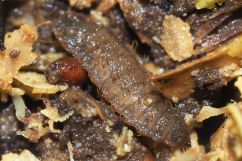
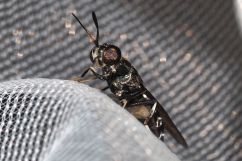
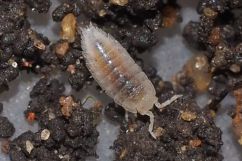
Continuing from last week’s post, I have found three more members of the decomposer community in my pots: Black Soldier Fly (Hermetia illucens) (Fig. 1), Woodlice (Fig. 2) and Compost Mites (Fig. 3). The black soldier fly larvae usually remain hidden in the compost, where their colouring makes them difficult to spot. I have seen them only occasionally, but recently spotted adult flies twice in my home, on 29 September and 27 October.
Woodlice, also known as terrestrial isopods, probably arrived in soil I brought home with wild plants. A few would emerge whenever I sprayed water on the soil surface. They may belong to the genus Trichorhina. The tiny compost mites seemed to appear out of nowhere; I would have overlooked them were it not for their sheer numbers on some days. Like spiders, they should have eight legs, although their size and the limitations of my photographic equipment prevented me from counting them. They probably belong to the suborder Oribatida.
 |
 |
 |
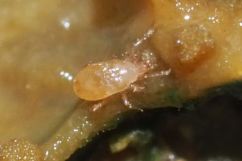 |
| Fig. 1: Larva and adult Black Soldier Fly (Hermetia illucens) | Fig. 2: Terrestrial isopod (Trichorhina species) | Fig. 3: Compost mite (suborder Oribatida) | |
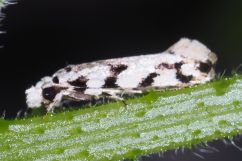
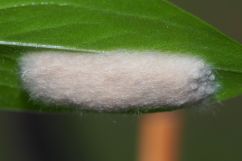
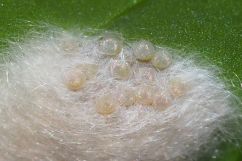
On 11 August, I spotted a Tortricid Leafroller Moth (family Tortricidae) (Fig. 4) on a young stem of Common Lantana (Lantana camara). Both of my potted lantanas were thriving and flowering profusely. Earlier, on 6 August, I had found a cluster of moth eggs (Fig. 5) beneath a leaf of a young Madagascar Periwinkle (Catharanthus roseus). Despite checking daily, I missed their hatching during the night of 9 August. By the next morning, all the eggs had hatched, but no caterpillars were in sight. I suspect predators may have eaten them. The eggs were unlikely to be related to the Tortricid Leafroller Moth.
 |
 |
 |
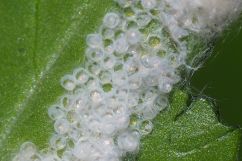 |
| Fig. 4: Tortricid Leafroller Moth (family Tortricidae). | Fig. 5: Nest of eggs of unknown moth species. Last image on the right showed the empty hatched eggs | ||
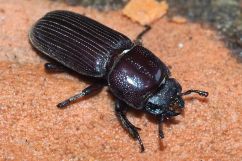
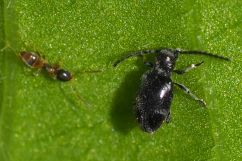
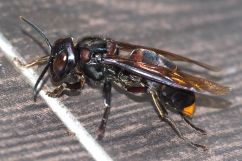
I also sighted two beetles and two wasps between July and September (Fig. 6 to 9). The Ghost Ant (Tapinoma melanocephalum) beside the Spider Beetle (Fig.7) shows how small the beetle is. This tiny ant is now the dominant ant species around my pots. The Square-headed Wasp (Fig. 9) may be Ectemnius embeliae; the only other Square-headed Wasp I have seen locally is Vechtia rugosa.
 |
 |
 |
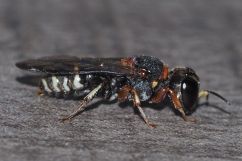 |
| Fig. 6: Ground Beetle (Oxycentrus species) | Fig. 7: Spider Beetle (Myrmecoptinus species) | Fig. 8: Yellow-vented Hornet (Vespa analis) | Fig. 9: Square-headed Wasp (family Crabronidae) |
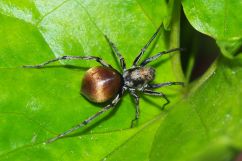
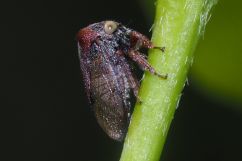
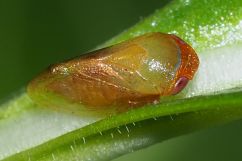
The final four visitors from the same period were two hoppers, a spider and an unidentified creature (Fig. 10 to 13). I rescued the female spider (Fig. 10) from water in the bathroom, where it had nearly drowned. This ant-mimic sac spider resembled a golden spiny ant (Polyrhachis beccarii). I spotted the unidentified tiny creatures (Fig. 13) beneath plant leaves several times. They were too small for me to tell whether they were bugs, moths or wasps. From a distance, they looked like specks of dirt clinging to the undersides of leaves.
 |
 |
 |
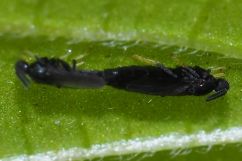 |
| Fig. 10: Ant-mimic Sac Spider (Corinnomma javanum) | Fig. 11: Treehopper (Tricentrus spinis) | Fig. 12: Leafhopper (Tartessus ferrugineus) | Fig. 13: Mating pair of unknown tiny insects |
I largely attribute the number and variety of these wild visitors to the park beside my apartment block. The plants I grow around my balcony also help attract them.